How to Pray at Work Without Feeling Awkward
Make prayer at work feel ordinary with a simple routine, a quiet space, and a calm sentence you can use when you need to step away.
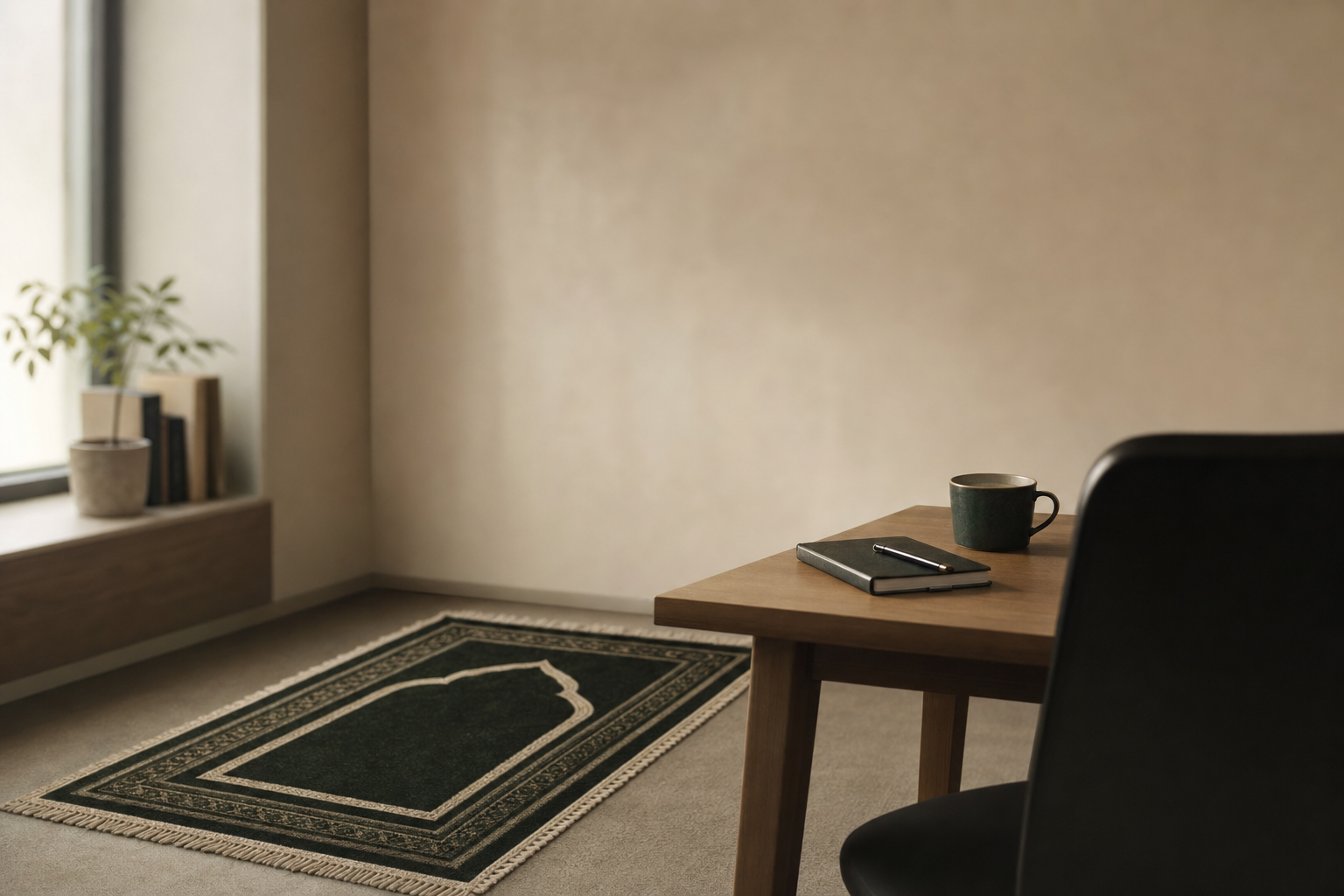
You pray at work without feeling awkward by making it simple, predictable, and ordinary. Know roughly when you need to pray, choose a clean and quiet place before the day becomes busy, and have one calm sentence ready if someone asks where you are going.
You do not need to apologise for praying, and you do not need to give a long explanation. A short, respectful line is usually enough: “I’m going to take a few minutes for prayer, then I’ll be back.” The more normal you make it, the more normal it often feels to everyone else.
Start with a private routine
Awkwardness often grows when you are deciding everything at the last minute. You look at the clock, realise the time is passing, search for a room, wonder who is watching, and then prayer begins to feel like a public event.
Try removing as many decisions as possible.
Before work, check the prayer times. Notice which prayer is likely to fall during your workday. If you can, decide where you will pray before you need to pray. It might be a small meeting room, a quiet corner, a wellness room, an unused office, or another clean low-traffic space.
If your workplace has a booking system, book a small room for a short time. You do not need to label it dramatically. A simple private booking can protect the space and reduce interruptions. If there are other Muslims at work, ask them quietly what they do. They may already know the easiest place, the best time, or the right person to ask.
The aim is not to create a perfect prayer setup. The aim is to make it easier to keep showing up.
Use one calm sentence
Many people feel awkward because they imagine they must explain everything: what prayer is, why it happens at certain times, why they are washing, why they need a quiet space, and whether it will affect the team.
Most of the time, you only need a short neutral explanation.
You can say:
“I’m stepping away for a few minutes to pray.”
“I have a short prayer break now. I’ll be back shortly.”
“I’ll rejoin in about ten minutes.”
That is enough. You are not asking your colleagues to understand every detail of your faith in that moment. You are simply letting them know you will be briefly unavailable.
If you work remotely or you are in a hybrid meeting, the same principle applies. Put a short status note, or send a brief message in the chat: “I need to step away for a few minutes and will rejoin shortly.” If your team already understands that you may step away around a known time, it becomes less disruptive and less noticeable.
You are allowed to be calm about something sacred.
Remember that it may feel bigger to you than to them
When you are the one leaving your desk, carrying a prayer mat, or asking for a room, it can feel as if the whole office is watching. In reality, people are often busy with their own tasks, deadlines, messages, and meetings.
The awkward feeling is real, but it is not always an accurate measure of how much attention you are receiving.
You may feel visible because prayer matters to you. Because you care. Because you do not want to be misunderstood. That sensitivity is not a flaw. But it does not have to control the whole experience.
Try to walk normally. Speak normally. Return normally. Do not rush back as if you have done something wrong. Prayer at work does not need to be a scene. It can be a quiet part of your day, like eating lunch, taking medication, or stepping out for fresh air.
And if someone is curious, you can be kind without feeling pressured. A simple answer is enough: “Muslims pray at set times during the day, so I take a few minutes when I need to.” Then you can carry on.
Handle meetings before they become a problem
If prayer often clashes with meetings, try not to wait until the difficult moment. Look ahead at your calendar. If a meeting overlaps with prayer time, check the agenda if there is one. You may be able to see whether your absence would fall during a section you can catch up on, or whether you need to be present for a decision.
If needed, ask early and simply:
“Would it be possible to move this by ten minutes?”
“I may need to step away briefly during this meeting, but I’ll catch up on anything I miss.”
“Could we cover my section before 1:30?”
For recurring needs, it may help to use the normal workplace process. Some workplaces have HR guidance, employee handbooks, manager approval routes, or room-booking policies for religious needs. You do not have to solve everything through awkward corridor conversations.
If you are unsure about a religious detail, such as what to do when prayer times are tight or travel is involved, ask someone knowledgeable whom you trust. Workplace planning is practical, but worship deserves care.
Prayer at work may never feel completely effortless, especially at the beginning. But it can become familiar. You are not trying to impress anyone. You are trying to keep a quiet appointment with Allah in the middle of an ordinary day.
Start with one small step today: choose the sentence you will use the next time you need to step away, and save it in your notes so you do not have to find the words under pressure.